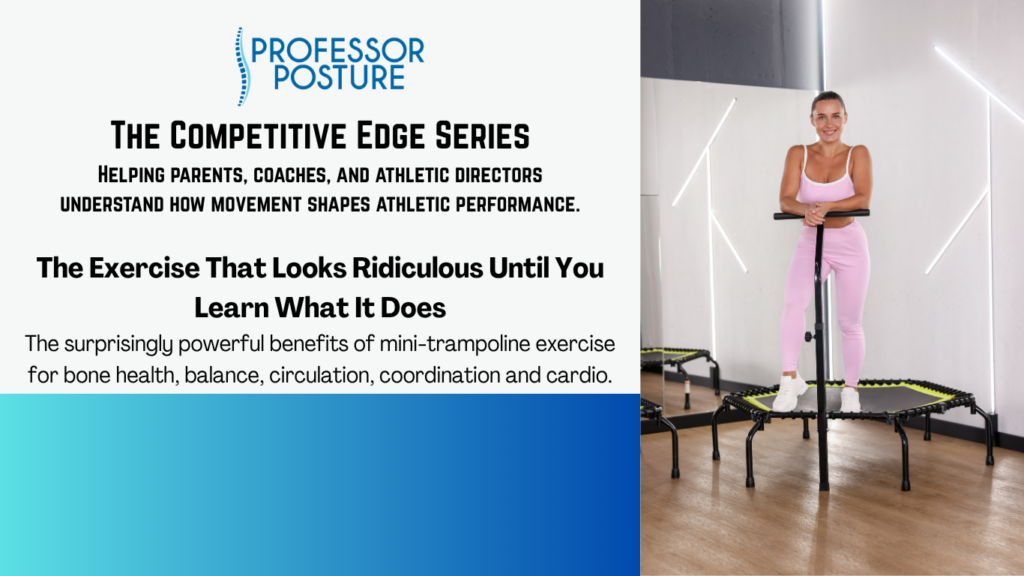
The surprisingly powerful benefits of mini-trampoline exercise for bone health, balance, circulation, coordination and cardio.
We’re going to take a brief side trip to explore how we can work all the muscles we’ve already talked about… the feet, the legs, the hips, and the psoas.
Let’s just get this out of the way.
Yes. I’m talking about bouncing on a mini trampoline.
Before you picture yourself in a leotard preparing for the Olympic gymnastics team, let me clarify.
We’re talking about rebounding—small, controlled, rhythmic movements on a mini trampoline or rebounder.
You don’t need to jump six feet into the air.
You don’t even need to get particularly high off the surface.
In fact, the magic of rebounding is partly in how little you actually have to move.
Because while it looks like you’re just bouncing around on a tiny trampoline, your body is doing considerably more work than you might realize.
Your feet are working.
Your muscles are constantly adjusting.
Your bones are receiving impact.
Your nervous system is processing information.
Your balance is being challenged.
Your coordination is working.
Your cardiovascular system is getting a workout.
You’re breathing harder.
And your lymphatic system is getting some help moving fluid through the body.
So yes, it looks a little ridiculous.
But once you understand what your body is actually doing, it starts looking a whole lot less ridiculous.
Your Bones Actually Want Some Impact
We’ve spent decades hearing that we should avoid impact.
And for certain injuries or conditions, reducing impact can absolutely be appropriate.
But impact itself isn’t bad.
Your bones are living tissue, and they respond to the forces placed on them.
That’s one reason weight-bearing and impact exercise are important for bone health.
And this isn’t just something we should care about when we’re 60.
Teenagers need impact, too.
Adolescence is an important period for building bone mass. A significant portion of our lifetime bone development happens during these growing years, which means the teenage years are a pretty important opportunity to build a strong foundation.
Exercise that loads the skeleton can help support bone development and bone mineral density.
In other words, if we’re waiting until someone develops osteopenia to start caring about bone strength, we’ve waited a little too long to become interested in the foundation.
And for adults, maintaining bone strength continues to matter.
Rebounding provides something walking doesn’t provide to the same degree:
controlled impact.
Walking is weight-bearing, but the impact is relatively low.
Running provides much more impact, but it also means repeatedly striking a relatively rigid surface.
A rebounder changes the equation.
The elastic surface absorbs and returns some of the force, allowing you to create impact without needing to launch yourself into the atmosphere.
You can keep the bounce small.
You can control the intensity.
You can increase it as your body adapts.
That’s what makes the rebounder’s surface such a game changer.
Your Feet Are Doing More Than Standing There
If you’ve been following our previous articles about the feet, you already know that I have a thing about feet.
And for good reason.
Your feet are your foundation.
Every time you bounce, your feet have to receive information from the surface and respond to it.
Where is your weight?
Are you centered?
Are you leaning?
Are you shifting to one side?
Are your toes gripping?
Is your ankle adjusting?
Your feet aren’t simply supporting you.
They’re communicating with your brain.
This is where proprioception comes into play—the body’s ability to sense where it is in space.
When you’re standing on solid ground, your nervous system gets a certain amount of information.
When you’re moving on an elastic surface that is constantly responding to your movement?
That’s a different conversation.
Your feet, ankles, knees, hips and trunk have to make continuous little adjustments to keep you centered and upright.
And your brain has to process all of that information.
Which brings us to another big benefit of rebounding:
balance.
Rebounding Is a Balance Workout in Disguise
When most people think about balance exercises, they picture someone standing on one foot while staring intensely at a wall.
But balance isn’t just something you practice while standing perfectly still.
Your body is constantly managing balance while you move.
That’s exactly what you’re doing on a rebounder.
You’re shifting your center of gravity.
You’re controlling your landing.
You’re adjusting your muscles.
You’re responding to the movement of the surface.
You’re coordinating your arms and legs.
And you’re doing it over and over again.
That’s balance, coordination and motor control all rolled into one activity.
And here’s something important:
Your brain doesn’t care that you bought a cute little trampoline.
It simply knows that the environment changed and it needs to figure out what to do about it.
So your nervous system starts gathering information and making adjustments.
Again.
And again.
And again.
That’s practice.
And the body gets good at what it practices.
More of Your Muscles Are Working Than You Think
Rebounding isn’t a traditional strength workout.
You’re not loading a barbell and doing squats.
But that doesn’t mean your muscles are taking the day off.
Far more of your body is working than you realize.
Your calves and feet are responding to each landing.
Your quadriceps and hamstrings are helping control the movement of your knees.
Your hips and glutes are stabilizing your pelvis.
Your core is helping keep your trunk controlled.
Your upper body contributes to balance and rhythm.
And all of those muscles have to communicate with one another.
That’s important because your body doesn’t move in isolated pieces.
When you walk, run, climb stairs, play a sport or pick something up off the floor, your body works as a coordinated system.
Rebounding gives that system something to do.
And it does it over and over again.
Then There’s the Cardio
Here’s where rebounding gets really interesting.
You don’t need to spend 45 minutes breathing like you’re being chased by a bear to get cardiovascular benefits.
Exercise should challenge your cardiovascular system, but that doesn’t mean every workout needs to leave you questioning your life choices.
Rebounding can provide meaningful cardiovascular exercise while allowing you to control the intensity.
Bounce gently and keep things easy.
Increase your pace and your heart rate goes up.
Add more arm movement.
Increase the bounce slightly.
Work a little harder.
You can adjust the intensity without changing the entire exercise.
Compare that with some of the traditional forms of cardio:
Walking: Great exercise and relatively low impact, but the movement pattern is repetitive and the cardiovascular demand may be limited unless you increase the pace or duration.
Running: Excellent cardiovascular exercise, but you’re repeatedly absorbing impact through a relatively rigid surface.
Cycling: Excellent cardiovascular exercise, but you’re seated and your feet aren’t experiencing the same weight-bearing demands.
Rebounding: Cardiovascular work, impact, balance, coordination, proprioception and whole-body movement—all at the same time.
And your neighbors don’t have to watch you march aggressively down the sidewalk.
Everybody wins.
But What About Cortisol?
You’ve probably heard that exercise can raise cortisol.
That’s true.
But here’s where the internet sometimes takes a perfectly normal physiological response and turns it into a horror story.
Exercise is a stressor.
Your body responds to that stressor.
Cortisol is part of that response.
That doesn’t mean cortisol is bad or that steady-state cardio is secretly destroying your body.
The response depends on factors such as intensity, duration, fitness level and the individual.
The bigger takeaway is much simpler:
You don’t have to make exercise miserable for it to be effective.
Rebounding allows you to challenge your cardiovascular system without automatically turning every workout into an endurance event.
You can work.
You can breathe harder.
You can raise your heart rate.
And you can stop before your workout becomes an audition for Survivor: Gym Edition.
Your Brain Is Involved, Too
Your brain doesn’t get to sit this one out.
Every bounce gives your nervous system information.
Your feet feel the surface.
Your joints sense movement.
Your muscles detect changes in length and tension.
Your inner ear helps monitor movement and position.
Your eyes are taking in information.
And your brain is coordinating all of it.
That’s a lot of communication happening while you’re doing something that looks like…
well…
bouncing.
You’re also breathing harder as your cardiovascular demand increases, which means your body is moving more oxygen through the system.
We’re not going to claim that rebounding magically makes you smarter.
There is enough nonsense on the internet already.
But movement, cardiovascular exercise, coordination and motor control all involve the brain.
And rebounding gives your brain a surprisingly complicated movement problem to solve.
Let’s Talk About Lymph
Now let’s talk about one of the most misunderstood systems in the body:
the lymphatic system.
At the 10,000-foot level, your lymphatic system is part of your body’s fluid-management and immune system.
Fluid constantly moves out of your blood vessels and into your tissues.
The lymphatic system collects some of that excess fluid, along with proteins, cellular material and immune cells, and transports it through a network of lymphatic vessels and lymph nodes before returning it toward the bloodstream.
Think of it as part of your body’s drainage and transportation system.
And unlike your cardiovascular system, which has the heart doing the heavy lifting as a central pump, lymph movement relies on several mechanisms—including muscle contractions, breathing and the rhythmic contractions of the lymphatic vessels themselves.
So what happens when you bounce?
Your muscles contract and relax.
Your body repeatedly changes position and pressure.
Your legs and trunk are moving.
You’re breathing.
You’re creating rhythmic movement.
All of that can help support the normal movement of lymphatic fluid.
Now, before somebody on TikTok starts promising that rebounding will “detox every toxin you’ve ever consumed”…
No.
Your liver and kidneys already have jobs.
Rebounding isn’t a magical detox button.
But rhythmic movement and muscle contractions can support the normal processes your body already uses to move lymph.
And honestly, that’s pretty cool without making up a detox fairy tale.
The Rebounder Is the Game Changer
This is probably the part I find most interesting.
Rebounding lets you combine impact and control.
That’s not something you get from every form of exercise.
Walking gives you weight-bearing movement, but relatively little impact.
Running gives you a lot more impact, but also creates repetitive loading.
The rebounder sits somewhere interesting in the middle.
You can create meaningful impact without needing a huge jump.
You can control how hard you work.
You can control how high you bounce.
You can slow down.
You can speed up.
And you can gradually increase the demand as your body becomes more comfortable with the movement.
That’s why I don’t want you thinking of rebounding as an “older person’s exercise.”
Teenagers can benefit from it.
They’re building bone.
Adults can benefit from it.
They’re trying to maintain strength, balance and cardiovascular fitness.
Athletes can benefit from it.
They’re constantly asking their bodies to coordinate movement and react to changing forces.
And older adults can benefit from appropriately scaled movement that challenges balance, coordination and cardiovascular fitness.
It’s not an age-specific exercise.
It’s a movement exercise.
How Do You Start?
Please don’t read this article, buy a rebounder tomorrow and decide you’re going to bounce for an hour.
That’s how you end up angry at me.
Start with 5–10 minutes.
That’s it.
Keep the bounce small.
Keep your knees soft.
Stay centered.
Pay attention to how your feet feel.
Focus on maintaining your balance rather than trying to bounce higher.
Some rebounders even come with a handlebar, which can give beginners an extra point of stability while they get comfortable.
As your body adapts, gradually increase your time and intensity.
And remember:
The goal isn’t to bounce higher.
The goal is to move well while you’re bouncing.
There is a difference.
So… Should You Be Rebounding?
At this point, you probably already know where I’m going with this.
Holy crap. You should probably be rebounding.
Not because it’s magic.
Not because it detoxes your body.
Not because it replaces every other form of exercise.
And definitely not because walking is suddenly bad.
Rebounding is simply a surprisingly efficient way to combine a whole bunch of things your body needs:
Impact.
Cardiovascular exercise.
Muscle activity.
Balance.
Coordination.
Proprioception.
Motor control.
Footwork.
Movement.
And you can adjust the intensity to meet your current ability.
That’s a pretty impressive list for a piece of equipment that basically looks like somebody shrunk a trampoline.
So the next time you see someone bouncing around on a mini trampoline, don’t laugh too quickly.
They may actually be onto something.
And if you’re in Tampa, there’s another very practical reason to consider it.
It’s hot in Tampa in September.
If you’re looking for a different way to exercise in Tampa, try rebounding.
Your feet, bones, muscles, brain and cardiovascular system might have more to say about it than you expect.
Just remember:
Performance doesn’t begin with how hard you work. It begins with how well you move.