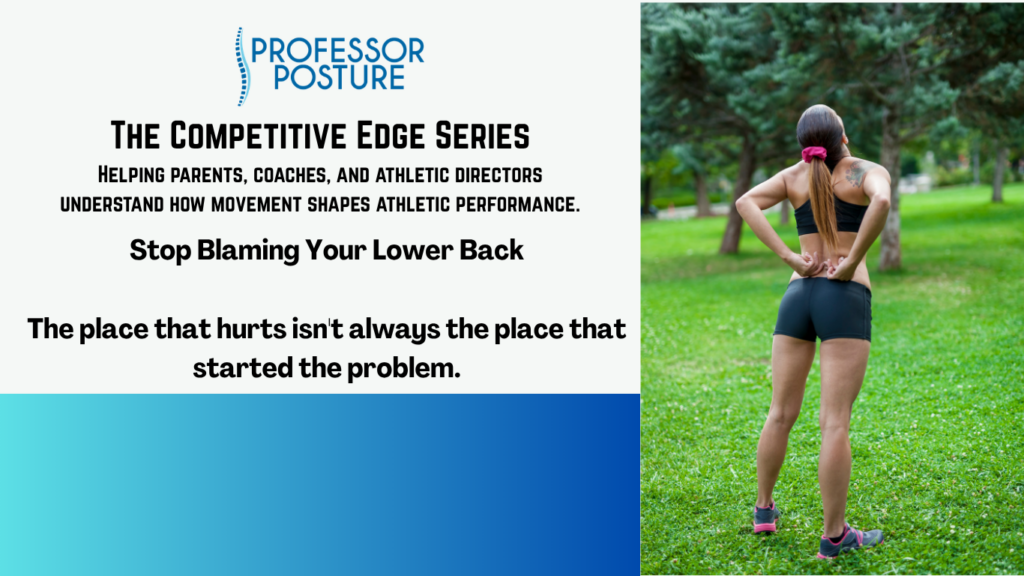
Why endless crunches may be reinforcing the very movement patterns contributing to your low back pain.
Your Core Isn’t What You Think It Is
Let’s talk about the word core.
Because somewhere along the way, we took a perfectly useful word and completely screwed it up.
Today, “core” has somehow become shorthand for abs.
Do crunches? Core.
Do sit-ups? Core.
Hold a plank until your entire body starts shaking? Apparently, that’s core too.
And if your low back hurts?
Obviously, you need to strengthen your core.
So you do more abs.
And then more abs.
And maybe more abs tomorrow, because apparently your low back is just waiting for that 47th crunch to finally get its act together.
This drives me absolutely nuts.
Because your core is not your abs.
Your abs are part of your core.
There’s a pretty important difference.
Let’s Start With Your Biceps
Think about something ridiculously simple: bringing a bottle of water to your mouth.
Your biceps shorten and contract to bend your elbow.
That’s called a concentric contraction—the muscle gets shorter as it produces force.
But your biceps don’t get to do that by themselves.
Your triceps, on the back of your upper arm, have to lengthen while your biceps shorten.
That’s an eccentric contraction. The muscle is still working, but it’s lengthening as it controls the movement.
The front and back of your arm have to coordinate.
If they don’t, your body finds another way.
Your elbow might flare.
Your upper arm might rotate.
Your shoulder blade might move differently.
Your body doesn’t stop and say, “Sorry, we’re experiencing a biceps-triceps coordination issue.”
It improvises.
Because that’s what bodies do.
And this isn’t unique to your arm.
This principle exists throughout your entire body.
The front and back of your body have to work together. Muscles have to shorten, lengthen, stabilize and release at the right time so the rest of the body can move.
That’s dynamic tension.
And it’s one of the most important concepts in understanding how your body actually works.
Your Muscles Are an Orchestra
I want you to stop thinking about your muscles as individual parts.
Think of them as an orchestra.
The violin doesn’t get to decide that it’s playing a completely different song today.
The percussion section can’t take the afternoon off and expect the rest of the orchestra to sound exactly the same.
The music works because everyone is coordinating.
Your body is no different.
No muscle is an island.
Every muscle depends on other muscles to help create movement, stability and control.
That’s why having a strong muscle doesn’t necessarily mean you’re going to have a strong movement pattern.
You can have strong individual players and still have a terrible orchestra.
And that’s exactly where we’ve gotten into trouble with the word core.
So What Is the Core?
The core isn’t the front of your stomach. It’s the system that connects and stabilizes everything from your shoulders to your hips and keeps your body organized while you move.
It’s the large stabilizing musculature throughout your trunk, pelvis, hips and shoulders—front and back.
It’s not just the rectus abdominis.
It’s not just the muscles that give you a six-pack.
And it’s not something that only works when you’re lying on the floor.
Your core is working when you stand.
When you walk.
When you carry groceries.
When you reach for something.
When you climb stairs.
When you run.
When you throw.
When you jump.
When you land.
When you change direction.
In other words, your core is supposed to be working while your body is moving.
That’s its job.
Not simply to make your stomach burn.
Strong Muscles Aren’t the Same as a Strong System
Here’s where things get really interesting.
You can have strong abdominal muscles and still have a body that doesn’t stabilize itself particularly well.
You can do 200 crunches and still have low back pain.
You can hold a plank for two minutes and still have lousy movement.
You can have visible abs and still compensate every time you move.
Why?
Because strength and coordination are not the same thing.
Your body doesn’t just need muscles that are capable of producing force.
It needs muscles that know when to produce force, how much force to produce, and which other muscles need to work with them.
That’s the orchestra.
That’s dynamic tension.
That’s the actual core.
Now Let’s Talk About Your Desk Job
Imagine you spend eight hours a day sitting at a computer.
Your head creeps forward.
Your shoulders round.
Your spine settles into flexion.
You spend hour after hour asking your body to exist in some version of that same general position.
Then you leave work and go to the gym.
And what do you do?
You lie on your back.
Crunch.
Crunch.
Crunch.
Sit-up.
Leg raise.
Crunch.
Maybe you finish with some bicycle crunches because apparently your abs haven’t suffered enough.
Here’s the problem:
If your body spends eight hours practicing flexion, you don’t fix that problem by spending another 20 minutes on the floor curling your torso forward.
Changing from a chair to a yoga mat doesn’t magically make the movement pattern different.
Your body doesn’t care what we call an exercise.
It responds to the position, movement and demands we give it.
That’s why I want to be very clear with the desk worker:
Stop doing abs.
At least stop thinking that doing more abdominal work is automatically going to fix your low back.
Because if you’re spending your entire workday in a shortened, flexed position and then deliberately training more of that same strategy, you’re not necessarily giving your body something new.
You’re practicing what it already knows.
And your body gets very, very good at what it practices.
But What Happens to Your Back?
This is where dynamic tension matters.
If the muscles on the front of your body are constantly shortened, the muscles on the back have to accommodate that position.
They become lengthened.
And if they’re held there long enough?
They’re stuck long, which means they can’t do their job well.
That doesn’t mean your back muscles aren’t working.
It means they aren’t working from a position where they can effectively do what they’re supposed to do.
So when you go to the gym and perform another round of abdominal exercises, you’re not necessarily “strengthening your back.”
You may actually be asking your back to remain in the same compromised relationship with the front of your body.
And that is one reason someone can throw their back out while doing an exercise they thought was supposed to protect it.
Their abs weren’t necessarily too weak.
Their entire system wasn’t coordinating well.
This Doesn’t Mean Crunches Are Evil
Let’s clear something up.
I am not saying crunches are evil.
I’m saying the idea that isolated abdominal strengthening is synonymous with core training is ridiculous.
And the idea that doing more abdominal work automatically makes your low back stronger?
Also ridiculous.
Your abdominal muscles are important.
Your back muscles are important.
Your hips are important.
Your shoulders are important.
Your pelvis is important.
They all have to work together.
The body is a coordinated system, not a collection of independent muscles.
That’s the part we’ve forgotten.
So What Should You Do Instead?
This is where things get much more interesting.
If the job of the core is to stabilize your body while you move, then maybe we should actually train it that way.
And no, that doesn’t require a fancy machine with twelve cables, three screens and a price tag that makes you question your life choices.
Start simple.
1. Crawl
If your knees tolerate crawling, crawl.
Seriously.
Crawling is phenomenal whole-body core training because your arms and legs are moving while your trunk has to remain organized.
Opposite limbs are working together.
Your shoulders and hips have to coordinate.
Your abdominal wall has to stabilize.
Your spine has to stay controlled.
And you’re doing all of that while moving through space.
That’s a lot more representative of how your body actually uses its core.
2. Stand on One Leg
Stand on one leg.
Try it for two minutes.
Then switch.
If two minutes is easy, close your eyes.
Just kidding.
Don’t do that yet.
Single-leg standing is deceptively simple, but your body has to make constant adjustments to keep you upright.
Your foot, ankle, knee, hip and trunk all have to participate.
Your core is working because your body has to stabilize around a constantly changing base of support.
And you didn’t have to lie down.
3. Get on a BOSU
If you have access to a BOSU or another balance surface, use it.
Start with both feet wide.
Then bring them closer together.
Try the ball side.
Try the platform side.
You can change the challenge without changing the basic movement.
Your feet are working.
Your legs are working.
Your hips are working.
Your abdominal wall is working.
Your back is working.
Your body is constantly making tiny adjustments to keep you upright.
That’s core training.
Not because we labeled it “core training.”
Because the demands of the exercise require your core to do its job.
4. Planks and Side Planks
Yes, planks can be useful.
Yes, side planks can be useful.
But only if your body can actually perform them well.
A plank isn’t automatically a good exercise because someone on Instagram told you to hold it for three minutes.
If your shoulders are collapsing, your back is sagging and you’re simply surviving until the timer goes off, you’re not winning a prize.
The goal isn’t to suffer.
The goal is to control your body.
5. Move
Eventually, this is the whole point.
Your goal isn’t to become really good at standing still.
Your goal is to become really good at stabilizing while you move.
That’s what your body needs.
And that’s where this becomes especially important for athletes.
Young Athletes Don’t Need 100 Crunches
I really want parents, coaches and young athletes to hear this.
A young athlete does not need to lie on the floor and do 100 crunches to “strengthen their core.”
That’s not what athletic core function looks like.
Think about what happens in sports.
A baseball player throws.
A soccer player sprints and cuts.
A basketball player jumps, lands and changes direction.
A volleyball player jumps and reaches.
A softball player rotates and throws.
A track athlete accelerates, decelerates and changes position.
None of those movements happen while the athlete is lying flat on their back.
If an athlete needs to stabilize their trunk while sprinting, throwing, jumping, landing, cutting and changing direction, then that’s what we should teach their core to do.
The arms and legs create movement.
The trunk has to organize and stabilize that movement.
That’s the job.
The goal isn’t to make a young athlete better at doing crunches.
It’s to make them better at controlling their body.
That’s a very different kind of training.
And it’s one reason the foundation of athletic performance has to begin with movement—not simply strength.
The Gym Rat Isn’t Off the Hook
And yes, I’m looking at you, gym rat.
I know you love your abs.
You have an ab circuit at lunch.
You have another one after your workout.
You have an app that tells you to do 300 mountain climbers before breakfast.
I’m not saying you can’t enjoy it.
I’m saying more isn’t automatically better.
If you’re spending your day sitting, then spending your workout repeatedly training isolated abdominal flexion may not be giving your body the variety it needs.
Your body needs movement.
It needs rotation.
It needs extension.
It needs lateral stability.
It needs balance.
It needs your arms and legs to move while your trunk controls what’s happening in the middle.
That’s a core.
Your Core Is a System, Not a Body Part
This is the part I want you to remember.
Your core isn’t a muscle.
It isn’t your six-pack.
It isn’t a 10-minute ab routine.
And it certainly isn’t something you can completely understand by looking at the front of your body in a mirror.
Your core is a system.
It’s the system that helps connect and stabilize your body from your shoulders to your hips.
It’s what helps keep you organized while your arms and legs move.
It’s what helps you transfer force.
It’s what helps you absorb force.
It’s what helps you maintain balance.
It’s what helps you move through the world without every movement turning into a compensation somewhere else.
And that matters whether you’re a desk worker, a weekend warrior, a gym rat or a young athlete.
Because the body doesn’t care whether you’re sitting at a computer in Tampa, swinging a baseball bat, running through Bayshore, or trying to keep up with your kids.
It has the same basic job:
Coordinate the system.
So the next time someone tells you that you need to “strengthen your core,” don’t immediately hit the floor and start doing crunches.
Ask a better question:
Does my body know how to stabilize while I move?
Because that’s the core you actually need.