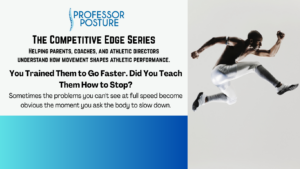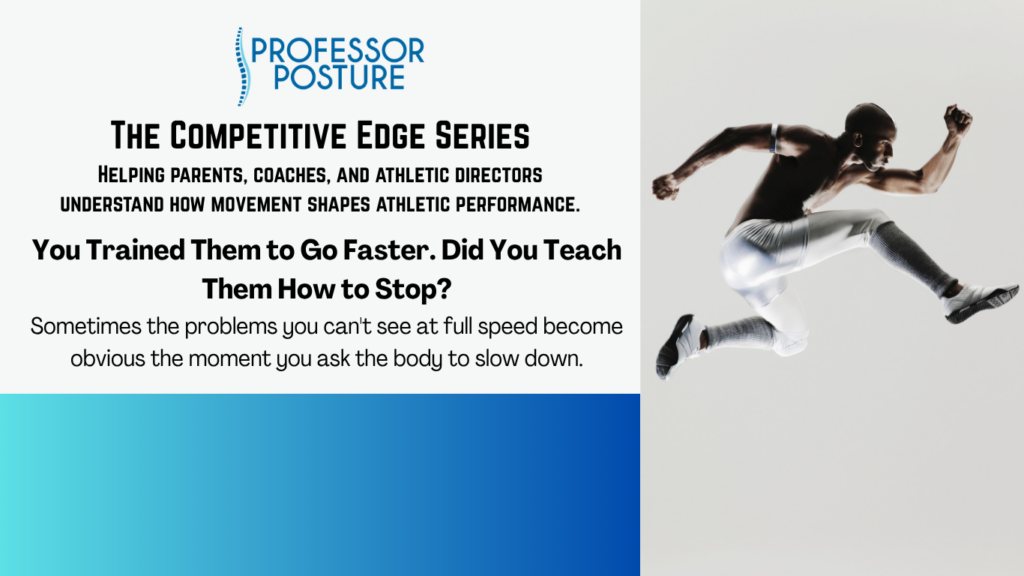
Sometimes the problems you can’t see at full speed become obvious the moment you ask the body to slow down.
Your kid can sprint. Great.
Can they land?
Can they stop?
Can they change direction without their entire body looking like it just received a surprise software update?
We spend a tremendous amount of time teaching athletes how to go faster, jump higher, lift heavier, throw harder, and push themselves further.
And I’m all for it.
But there is another side of movement that doesn’t get nearly as much attention.
What happens when they have to slow down?
Because acceleration gets all the glory. Deceleration tends to get treated like the boring part.
It isn’t.
In fact, I would argue that learning to control the body while slowing down, landing, stopping, or changing direction is just as important as learning how to create the movement in the first place.
And this is where things get very Professor Posture.
The “Negative” Part of Movement Isn’t Negative
We tend to think of movement as the exciting part.
Push off.
Sprint.
Jump.
Accelerate.
Go.
But eventually, something has to happen next.
You have to stop.
You have to land.
You have to change direction.
You have to absorb the force you just created.
That is movement, too.
We sometimes call this the “negative” part of an exercise or movement. But there is nothing negative about it.
It is simply the other side of the equation.
Your body doesn’t only need to know how to produce force.
It needs to know how to control force.
And if you can’t control the force you’re producing, eventually something has to absorb it.
That something is your body.
Fast Movement Can Hide a Lot
Here’s something I’ve learned over and over again working with clients at Professor Posture:
The body can compensate really well.
Especially when it’s young.
Especially when it’s motivated.
Especially when it’s moving at 100 miles per hour.
A young athlete can sprint, cut, jump, and keep going without anyone noticing that something isn’t moving particularly well.
They’re athletic.
They’re strong.
They’re fast.
They can do the thing.
So what’s the problem?
Sometimes we don’t see the problem because the body is moving too quickly for us to see it.
Speed creates momentum.
Momentum can cover a lot of sins.
Slow the movement down, however, and suddenly we can see things that were hiding in plain sight.
A foot that doesn’t want to stay stable.
A knee that wants to collapse inward.
A hip that isn’t controlling the movement very well.
A torso that has to compensate to keep everything moving.
A person who can get into a position but can’t actually control how they get there.
That last one matters.
Because being capable of getting somewhere isn’t the same thing as being capable of controlling the journey.
Slow Down and the Body Has to Actually Do the Work
This is one of the reasons I love controlled posture exercises.
They’re not flashy.
Nobody is going to put a slow, controlled posture exercise on Instagram with a dramatic soundtrack and have everyone lose their minds.
And that’s okay.
Because the goal isn’t to look impressive.
The goal is to make the body move with control.
When you slow a movement down, you take away some of the momentum that helps the body cheat.
Now it has to organize itself.
It has to find balance.
It has to control the position.
It has to figure out where the force is going.
And suddenly, we can see things we couldn’t see when the body was simply powering through.
Slow movement can look beautiful because you’ve given the body time to organize it. Speed tells you what you’ve actually got.
That doesn’t mean athletes shouldn’t move fast.
Quite the opposite.
I want athletes to be fast.
I want them to be powerful.
I want them to be able to sprint, jump, cut, throw, swing, and compete.
But I also want them to have the movement control necessary to handle everything that speed creates.
The Body Only Gets Good at What It Practices
This is one of my favorite Professor Posture-isms:
The body only gets good at what it practices.
If all we practice is acceleration, we’re practicing acceleration.
If all we practice is jumping, we’re practicing jumping.
If all we practice is lifting heavier, we’re practicing lifting heavier.
But what are we practicing when we land?
What are we practicing when we stop?
What are we practicing when we change direction?
What are we practicing when we have to absorb the force we just created?
Those aren’t throwaway moments.
Those are skills.
And they deserve to be trained like skills.
Try This: The Single-Leg Landing Test
Here’s a simple way to start thinking about this.
Stand on one leg.
Then perform a small jump and land on that same leg.
Don’t worry about jumping high.
In fact, don’t try to impress yourself.
The goal is to land and control the movement.
Can you land quietly?
Can you hold the position?
Can you keep your balance without immediately touching the other foot down?
Does your knee stay relatively controlled?
Does your foot stay connected to the floor?
Does your torso remain reasonably organized?
Most importantly:
Can you control the landing instead of simply surviving it?
Now try it again, but add a small change of direction.
Jump forward and slightly to one side. Land on one leg and control the landing.
Now things get more interesting.
Because you’re not just producing force anymore.
You’re producing force, changing direction, and then asking your body to control the result.
That’s athletic movement.
And that’s exactly why deceleration matters.
This Isn’t About Doing More Exercises
Here’s where I want to make an important distinction.
Deceleration isn’t some magical new category of exercise that you need to add to an already ridiculous workout schedule.
At Professor Posture, deceleration and control are already built into the way we work.
Every controlled posture exercise asks the body to manage movement.
Every time we slow down a movement and ask someone to stay balanced, stable, and organized, we’re teaching the body to control itself.
Then, when a client is ready, we can progress that into more dynamic movements.
Supersets.
Single-leg work.
Landing.
Changing direction.
Moving from one position to another.
The exercises change.
The principle doesn’t.
Can your body control the movement it’s making?
That’s the question.
And This Is Where Injury Prevention Comes In
When I talk about posture, I am not talking about standing up straight and looking like you’ve swallowed a yardstick.
Posture is so much bigger than that.
It’s about how your body organizes itself while you move.
It’s about whether you can move fluidly and freely.
It’s about whether you can create force, control force, change direction, recover your balance, and keep moving without constantly asking another part of your body to pick up the slack.
Because compensations don’t necessarily disappear when the movement ends.
Your body remembers them.
A movement that repeatedly requires compensation can eventually contribute to restricted movement, persistent muscle tension, loss of mobility, and pain.
And sometimes that process starts long before anyone considers themselves “injured.”
That’s particularly important for young athletes.
A 12-year-old body can get away with a lot.
That doesn’t mean it should.
Just because your athlete can sprint, jump, cut, or land doesn’t mean we should constantly ask them to do it at their absolute limit.
There is a difference between capacity and control.
And developing both matters.
Performance Isn’t Just About Going
The question isn’t:
How fast can you go?
It’s:
How well can you control yourself once you’re there?
That’s the part of athletic performance that doesn’t always get the attention it deserves.
And it’s not just for athletes.
It’s for the weekend golfer who has to stop and change direction.
The runner who has to manage the force of every foot strike.
The person who wants to keep hiking, playing tennis, skiing, lifting, chasing their kids, or doing whatever physical activity makes them happy.
Movement doesn’t stop being important just because you’re not competing.
Your body still has to manage force.
It still has to balance.
It still has to adapt.
It still has to stop.
At Professor Posture, that’s what we mean when we talk about movement.
We’re not interested in making your body look perfect while standing still.
We’re interested in helping it move well.
Because movement should feel fluid.
It should feel free.
And it should be something your body can control—not something it simply survives.
Go faster.
Jump higher.
Lift heavier.
Absolutely.
Just don’t forget to teach your body what to do when all that force has to go somewhere.
Because acceleration may get you there.
Control is what keeps you moving.