How your brain and nervous system develop movement patterns, create compensations, and influence posture, balance, coordination, and chronic pain
Have you ever noticed that when you type something incorrectly on your phone, autocorrect keeps trying to replace it with the same wrong word? You correct it once, twice, maybe three times, and somehow your phone is still convinced it knows better.
Your body can be a little like that.
Your brain is constantly receiving information from your body, processing it, and deciding how to respond. It learns from your experiences, adapts to your environment, and develops movement strategies that allow you to accomplish the things you ask it to do.
But here’s the catch: your brain doesn’t necessarily choose the best way to move. It often chooses a way that’s familiar, predictable, and gets the job done.
Sometimes that means finding a shortcut. Sometimes it means avoiding a movement that causes discomfort. And sometimes it means getting really good at a movement pattern that isn’t doing your body any favors.
The good news? Those patterns can be changed. But first, we need to understand who’s making the decisions.
Your Brain Is Running the Show
Every time you move, there’s a whole lot happening behind the scenes.
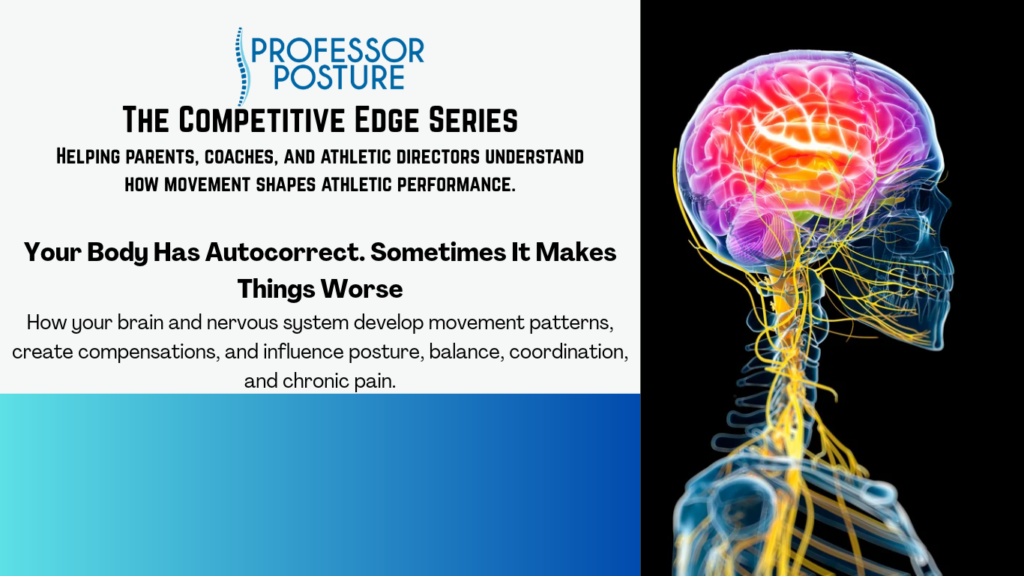
Your brain and nervous system are in constant communication with your body. They’re receiving information about where you are, how you’re moving, what’s happening around you, and whether adjustments are needed.
Think of it as a continuous conversation.
Sensory nerves carry information from your body toward your brain and spinal cord. They report things like position, movement, pressure, and discomfort. Motor nerves carry instructions in the other direction, communicating with your muscles and telling them when and how to contract.
Your brain processes that information and coordinates a response. Your body then sends more information back, allowing your nervous system to make adjustments while you’re moving.
This happens constantly.
You don’t consciously tell every muscle in your leg when to contract while walking. You don’t calculate how far to move your arm when reaching for your coffee. Your nervous system coordinates an enormous number of details without requiring you to supervise every single one.
Thank goodness. Most of us have enough going on without having to micromanage our hamstrings.
But this communication system does something else that’s particularly important: it helps your brain understand where your body is and what it’s doing.
Your Body Has a Built-In GPS
It’s called proprioception, and it’s one of the most important components of movement that people rarely think about.
Proprioception is your body’s ability to sense the position and movement of its different parts without having to look at them.
Close your eyes and touch your nose.
Easy, right?
You didn’t need a mirror, a measuring tape, or someone standing in front of you giving directions. Your brain already had enough information to know where your hand was and where it needed to go.
That’s proprioception at work.
Specialized sensory receptors in your muscles, tendons, and joints provide information about position, movement, and tension. Your brain uses that information to coordinate movement and help maintain control.
Think about walking across uneven ground, stepping off a curb, climbing a ladder, or changing direction while playing baseball. Your body needs to know where it is and how it’s moving, often before you have time to consciously think about it.
Your brain also uses information from your eyes and your vestibular system, which helps detect head movement and orientation, to maintain balance.
These systems work together.
That’s why standing on one foot with your eyes open is considerably easier than standing on one foot with your eyes closed. You’ve removed one of the sources of information your brain uses to keep you upright.
And here’s something worth remembering: balance isn’t simply a matter of having strong legs. Your muscles need to produce force, but your nervous system also needs to know how to coordinate those muscles at the right time and in the right amount.
Which brings us to a common misconception.
Strong Doesn’t Mean Coordinated
Let’s say you have someone who can squat 300 pounds.
Impressive? Absolutely.
Now ask that same person to perform a slow, controlled single-leg squat.
Suddenly, things might get interesting.
Their knee drifts inward. Their pelvis shifts. Their trunk leans to one side. They struggle to control the descent or push themselves back up without losing their balance.
How can someone be strong enough to squat 300 pounds but struggle to control their own body on one leg?
Because strength and coordination are two different things.
Strength is the ability to produce force. Coordination is the ability to organize movement so different muscles and body segments work together effectively. Stability is the ability to control your body and maintain appropriate positions while forces are acting on it.
These abilities work together, but they aren’t interchangeable.
You can have strong muscles without having particularly good movement control. You can build impressive strength while continuing to reinforce the same movement compensations you’ve been using for years.
A baseball player, for example, needs more than strong legs, hips, and shoulders. They need those body parts to work together in the right sequence when throwing, hitting, sprinting, and changing direction.
The same applies to everyday life.
An electrician working overhead, a landscaper lifting equipment, or someone carrying groceries up a flight of stairs needs more than individual muscle strength. They need coordinated movement.
Being strong is great. Knowing how to use that strength is even better.
Your Brain Loves a Shortcut
Your brain is constantly looking for ways to accomplish tasks using the information and movement strategies available to it.
It likes familiar patterns because familiar patterns are predictable.
But sometimes those patterns develop for a reason that isn’t particularly helpful in the long run.
Imagine you roll your ankle.
Initially, walking normally might be uncomfortable, so you shift your weight toward the opposite leg. You shorten your stride, change how your foot contacts the ground, and adjust how your hips and trunk move.
Your brain is doing exactly what it’s supposed to do. It’s trying to help you accomplish the task while avoiding discomfort.
That’s a protective movement strategy.
And in the short term, it may be exactly what you need.
But let’s say your ankle heals and the discomfort goes away. You start walking normally again, or at least you think you do.
Except you’ve gotten comfortable shifting your weight. Your opposite leg has been doing more of the work. Your pelvis may have adapted to that uneven loading, your trunk may have started rotating differently, and other muscles may be working harder to accommodate the changes.
One adjustment has influenced several others.
Eventually, you may have developed a whole-body movement strategy around an ankle that no longer hurts.
Your brain has essentially found a workaround and gotten very comfortable using it.
This is how compensations can become deeply ingrained. One protective adjustment can influence how other joints and muscles participate in movement. The body finds a way to get the job done, and the longer that strategy is repeated, the more familiar it can become.
This doesn’t mean every compensation causes pain or that every movement difference needs correcting. But it does mean the body can continue using a strategy long after the original reason for adopting it has disappeared.
And that’s an important distinction when we talk about chronic pain and movement limitations.
The place where you notice discomfort isn’t necessarily where the movement problem began.
Your Daily Routine Is Training You
Here’s something people don’t always consider: your workout isn’t the only thing teaching your body how to move.
Your job, your hobbies, your daily routines, and even the positions you spend hours in are all contributing to your movement habits.
Let’s look at a few examples.
The Desk Jockey
Sitting has gotten a pretty bad reputation.
But sitting itself isn’t the enemy. You can sit with your muscles actively participating. You can shift your weight, change positions, engage your trunk, and move.
The problem is spending eight hours in essentially the same position with very little muscular participation.
Your muscles and joints aren’t getting much opportunity to explore different positions, manage different loads, or move through different ranges.
Then you finish your workday, head to the gym, and expect your body to be ready for everything.
That’s quite a transition.
Imagine spending eight hours practicing a very limited selection of movement options and then expecting your body to suddenly perform a wide variety of movements with strength, coordination, and control.
Your body needs movement variety. It needs opportunities to load, unload, rotate, reach, bend, extend, and coordinate different parts of the body.
You don’t have to abandon your desk. You just have to stop treating your muscles like they’ve been given the day off.
The Laborer
Now let’s consider someone whose job requires physical activity all day.
An electrician might spend hours working overhead, reaching into tight spaces, rotating through the trunk, and positioning their body to access whatever they’re working on.
A landscaper might repeatedly bend, lift, carry, and rotate while loading equipment.
A plumber might spend much of the day kneeling, crawling, twisting, and working in confined spaces.
These jobs require strength, endurance, and coordination. But they also tend to involve repetitive movement patterns.
Consider the electrician who spends years reaching overhead with one arm while rotating through the same direction to access equipment. Over time, that person may develop noticeable differences in shoulder positioning, hip alignment, and trunk rotation.
Their body is adapting to the demands of the job.
But adapting to a job and developing well-rounded movement capabilities aren’t necessarily the same thing.
Being physically active all day doesn’t guarantee you’re moving through a balanced variety of positions and directions.
You can work hard physically and still have movement limitations.
The Gym Rat
And then there’s the person who spends several hours a week in the gym.
They lift weights, follow a program, and progressively increase resistance.
That’s great.
But if every workout reinforces the same limited movement patterns, they may be getting stronger without developing the coordination and control needed for other physical demands.
You can become exceptionally good at performing a particular exercise without becoming exceptionally good at moving your body in general.
And here’s the part I want gym enthusiasts to consider:
You can spend years getting stronger at a movement pattern that your body shouldn’t have been relying on in the first place.
If your knee consistently collapses inward during a squat, adding more weight doesn’t automatically teach your body to control that knee position. If you repeatedly rotate through your lower back instead of distributing movement through your hips and trunk, increasing the resistance doesn’t necessarily correct that strategy.
More weight isn’t always the answer.
Sometimes the answer is learning to move better with the weight you already have.
The Athlete You’re Building Today
This is particularly important when we’re talking about young athletes.
Children aren’t just developing strength, speed, and sport-specific skills. They’re developing the movement strategies they’ll rely on as the physical demands of their sport increase.
Think about a young baseball player.
They need to run, accelerate, decelerate, rotate, throw, jump, land, and change direction.
Each of those activities requires a combination of strength, balance, proprioception, coordination, and body awareness.
And these abilities don’t automatically develop just because a child practices baseball several times a week.
Sport-specific training is important, but it doesn’t replace a broader movement foundation.
A young athlete who can throw hard but struggles to control their trunk rotation, stabilize on one leg, or coordinate their lower and upper body has some important movement skills left to develop.
We spend a tremendous amount of time teaching kids how to perform the skills of their sport. We also need to give them opportunities to develop the movement capabilities that support those skills.
At NextGen Performance Lab, this is a central part of the philosophy.
Performance begins long before strength. It begins with movement.
We want young athletes to develop the ability to control their bodies, understand where they are in space, coordinate different body segments, and respond to changing physical demands.
Because the movements they practice today become part of the movement strategies they rely on tomorrow.
And the more demanding the sport becomes, the more important those foundational abilities become.
Doing Exercises Isn’t the Same as Retraining Movement
Here’s where I want to make an important distinction.
Exercise and movement retraining are not necessarily the same thing.
You can perform hundreds of squats, lunges, and bridges without ever changing the movement strategy your body uses to perform them.
If you consistently shift your weight to one side during a squat, for example, simply doing more squats may reinforce that familiar pattern.
You might get stronger. You might increase the amount of weight you can lift. But that doesn’t automatically mean you’ve improved how your body distributes force or coordinates the movement.
Getting stronger at a compensation isn’t the same as correcting it.
Movement retraining requires a different approach.
It starts with recognizing what your body is doing. Then you work on developing the control, coordination, and awareness needed to perform the movement differently.
Sometimes that means slowing down. Sometimes it means reducing resistance. Sometimes it means breaking a complicated movement into smaller pieces before putting everything back together.
The goal isn’t simply to complete the exercise. It’s to give your nervous system an opportunity to learn a different movement strategy.
And that requires intentional practice.
This is a big part of corrective posture therapy. We’re not simply trying to make muscles stronger or stretch muscles that feel tight. We’re looking at how the body moves as a whole and helping it develop better ways to manage movement and physical demands.
The brain and nervous system are adaptable. With appropriate feedback, practice, and repetition, new movement strategies can be learned.
You aren’t stuck with the movement habits you’ve developed over the years.
But you do have to give your body something different to practice.
Try This: Your Brain Is Doing More Than You Think
Here’s a simple exercise you can try at home.
Stand upright with your feet about hip-width apart. Begin marching in place at a comfortable, deliberate pace.
Notice how your weight shifts from one foot to the other. Pay attention to whether your trunk stays controlled, whether your shoulders remain relatively level, and whether you can lift each knee without leaning or swinging your body excessively.
Now gradually increase your marching speed.
What changes?
Do your movements become less controlled? Do your shoulders begin moving excessively? Does your trunk start rotating or leaning? Do you find yourself using momentum instead of controlling the movement?
Try slowing down again.
The goal isn’t to pass or fail a test. It’s to notice how your body responds when the speed and demands of a movement change.
Your brain is coordinating information from your eyes, muscles, joints, and balance systems to help you perform this seemingly simple task.
And when the demands change, your nervous system has to adjust.
That’s movement control in action.
Your Body Can Learn a New Way
Your body is incredibly adaptable. It responds to the demands you place on it, the positions you spend time in, the movements you repeat, and the experiences you have.
Sometimes those adaptations are exactly what you need.
Other times, they create movement strategies that aren’t particularly useful anymore.
You might be strong but lack coordination. You might be physically active but still have limited movement variety. You might have recovered from an injury but continue using the same compensations you developed while protecting yourself.
None of that means you’re stuck.
It means there’s an opportunity to teach your body something different.
This is why corrective movement isn’t simply about strengthening weak muscles or stretching tight ones. It’s about helping the body develop better movement options, improve coordination, and learn to manage physical demands more effectively.
At Professor Posture in Tampa, Florida, this is the foundation of corrective posture therapy. We look beyond individual symptoms and consider how the body moves as a whole, because the place where you notice a problem isn’t always where the movement problem began.
You don’t have to accept the movement patterns your body has developed. You can teach it something different. But first, you have to recognize what you’ve been practicing.
Your body is constantly practicing something. The question is whether you’re practicing the movements you actually want to get good at.