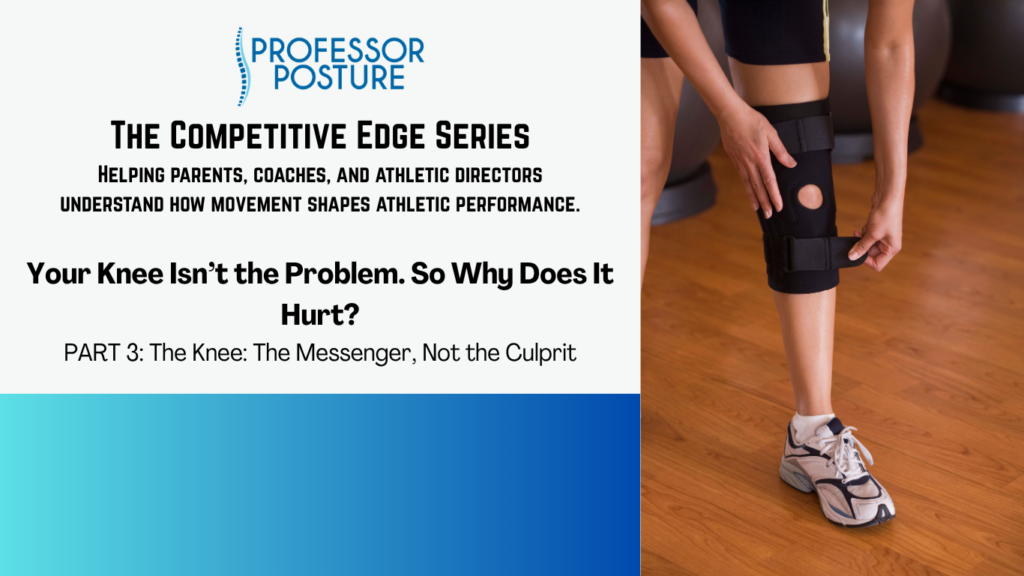
When the foot, ankle, and hip stop doing their jobs, the knee may be asked to do far more than it was designed to do.
The Knee Is the Middleman
If you’ve been following along, we’ve already talked about the foot and why it matters so much more than most people realize.
Your feet aren’t weak. They’re underworked.
And when the foot isn’t moving and responding the way it was designed to, the rest of the body has to figure out what to do about it.
That’s where the knee comes into the conversation.
The knee gets blamed for a lot.
Knee pain. Knee injuries. Knee instability. Knee braces. Weak knees. Bad knees.
But here’s the thing:
The knee is often being asked to solve a problem that didn’t start at the knee.
When the Ankle Doesn’t Move
Let’s start at the bottom.
We’ve already established that the foot needs to move. But the ankle needs to move, too.
Your ankle needs to be able to dorsiflex—bringing the shin forward over the foot—and plantarflex—pointing the foot away from the body.
That movement matters every time you walk, run, jump, squat, land, climb stairs, or change direction.
Now imagine an ankle that doesn’t have enough dorsiflexion.
The body still has to get the job done.
So it finds another way.
And one of those ways may be asking the knee to move farther, rotate differently, or absorb forces it wasn’t really designed to handle.
The knee isn’t necessarily weak.
It may simply be compensating.
That’s an important distinction.
Because if we see a knee that isn’t behaving well and our first thought is, “We need to strengthen the knee,” we may be treating the employee instead of asking why the boss gave them three other people’s jobs.
Then There’s the Hip
Now go in the other direction.
The hip is a remarkably mobile joint. It is designed to move through multiple planes and help control the position of the entire leg.
That movement is especially important when you’re doing something athletic.
Running.
Jumping.
Cutting.
Landing.
Changing direction.
Squatting.
The hip needs to contribute.
But if the hip doesn’t move well—or doesn’t have the ability to control movement—the knee may once again be asked to pick up the slack.
And this is where things get interesting.
Because the knee is sitting between two joints that are supposed to be doing a lot of moving and adapting.
If the foot and ankle don’t move enough, the knee may have to move more.
If the hip doesn’t move or control movement well, the knee may have to move differently.
Suddenly, this little joint in the middle is being asked to manage forces coming from both directions.
That’s a lot of responsibility for a joint whose primary job is supposed to be stability.
Stability Doesn’t Mean “Don’t Move”
This is an important distinction.
When we say the knee is designed for stability, we’re not saying the knee shouldn’t move.
Obviously, it bends and straightens all day long.
Stability means the knee should be able to control the movement happening around it.
It should be able to accept force.
It should be able to transfer force.
It should be able to keep the leg organized while the foot and hip do their jobs.
That’s very different from asking the knee to become the primary stabilizer for the entire lower body.
And this brings us to something parents and coaches see all the time:
the knee brace.
So… Is the Brace the Problem?
No.
A brace isn’t automatically bad.
There are absolutely situations where additional support can be useful. A brace can provide external stability while someone is recovering, participating in an activity, or dealing with a knee that genuinely needs additional support.
But when we see a young, otherwise active child who routinely needs external stability around the knee, I think it’s worth asking a different question.
Not:
“Is the brace bad?”
But:
“Why does this knee need the brace?”
That’s a much better question.
Because a brace can help stabilize the knee.
It can’t make the hip move.
It can’t restore ankle dorsiflexion.
It can’t make the foot respond to the ground.
And it certainly can’t teach the entire lower body how to work together.
If a young athlete needs additional stability around the knee, I want to know why.
What is the knee being asked to do?
What isn’t happening at the foot?
What isn’t happening at the ankle?
What isn’t happening at the hip?
And eventually, what isn’t happening around the pelvis and SI joint?
Those questions can tell us much more than simply looking at the knee.
The Body Doesn’t Work in Isolated Parts
This is one of the biggest ideas I want you to take away from this entire series.
Your body doesn’t have a separate department for your foot, another department for your knee, and another department for your hip.
They have to work together.
When you walk, your foot interacts with the ground.
That movement travels up the leg.
The ankle responds.
The knee controls and transfers movement.
The hip moves and controls the position of the leg.
The pelvis helps organize the relationship between the legs and the rest of the body.
It’s a conversation.
And when one part stops contributing, another part usually has to speak louder.
Sometimes that louder voice is pain.
Sometimes it’s instability.
Sometimes it’s poor performance.
Sometimes it’s a recurring injury.
And sometimes it’s nothing obvious at all—yet.
That’s why I don’t want us to look at a young athlete and simply say, “Their knees aren’t stable.”
I’d rather ask:
Why aren’t their knees able to be stable?
Because the knee may not be the problem.
It may be the place where the problem finally became impossible to ignore.
Before We Blame the Knee
The next time you see a knee that doesn’t seem to be doing its job, take a step back.
Look down at the foot.
Does it move?
Can it adapt?
Can the ankle dorsiflex?
Can the ankle plantarflex?
Then look up.
Does the hip have the mobility it needs?
Can it control the leg?
Can it contribute when the athlete runs, jumps, lands, or changes direction?
And eventually, we need to look even higher.
Because the pelvis and SI joint play their own role in how the entire lower body moves and transfers force.
We’re going to get there.
But for now, remember this:
The knee doesn’t exist to make up for everything the rest of the leg isn’t doing.
It’s supposed to be part of a team.
And when the whole team does its job, the knee doesn’t have to work overtime just to keep everyone else functioning.
That is the kind of stability we’re really after—not simply making the knee harder, tighter, or more supported.
We’re looking for a body that knows how to support itself.