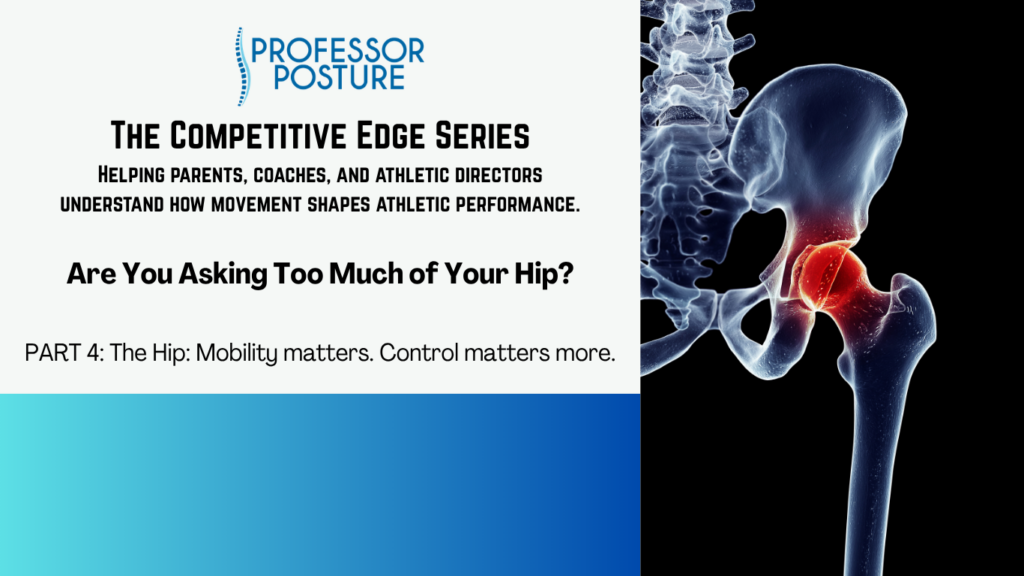
Are You Asking Too Much of Your Hip?
Mobility matters. Control matters more.
We’ve spent the last two chapters working our way up the body.
We started with the foot because everything has to start somewhere.
The foot is your foundation. It meets the ground, adapts to the surface underneath you, and helps your body figure out what to do with the forces coming up from the ground.
Then we moved to the knee.
The knee is built for stability. It bends and straightens, but one of its most important jobs is providing a stable connection between the foot and the hip.
And now we get to the hip.
This is where things get really interesting.
Because if the foot is your foundation and the knee is your stabilizer, the hip is one of the body’s major control centers.
And understanding that changes the way we should think about hip mobility, athletic performance, posture, and even injury prevention.
The Hip Isn’t Just Where Your Leg Attaches
When most people think about the hip, they probably think about flexibility.
Can you touch your toes?
Can you bring your knee to your chest?
Can you rotate your leg?
Can you stretch your hip flexors?
Those are all movements the hip can perform.
But here’s the problem:
Being able to move isn’t the same thing as being able to control movement.
You can have a very flexible hip and still have a hip that isn’t particularly good at controlling what your body is doing.
And control matters.
A lot.
Especially when we’re talking about young athletes.
Think about what happens when an athlete runs.
Their foot hits the ground.
The foot has to respond.
The ankle has to move.
The knee has to manage stability.
And then the hip has to decide what happens with all of that movement.
When they cut to the left, the hip has to help control the position of the leg.
When they jump, the hip helps produce and organize force.
When they land, the hip has to help control where that force goes.
When they sprint, the hip is involved in creating movement while helping organize the relationship between the leg and the rest of the body.
The hip isn’t just along for the ride.
It’s helping drive the bus.
And Then There’s the Problem of Sitting
Now let’s bring this back to the young athlete we’ve been talking about.
We know what they’re capable of doing when they’re actually playing their sport.
But how much time are they spending not moving?
School.
Homework.
Commuting.
Gaming.
Phones.
Television.
Studying.
Sitting around between activities.
It can add up to an enormous amount of time.
A young athlete can spend hours training their body to run, jump, throw, cut, and compete—and then spend the majority of the rest of the day sitting.
For many young people, the amount of time spent sitting during school, transportation, homework, gaming, and screen time can be surprisingly high.
The body doesn’t necessarily care that those hours are labeled “school,” “gaming,” or “car ride.”
It just knows what you’re asking it to do.
And if you’re asking it to sit for hours and hours, you’re practicing sitting.
Then you expect it to immediately switch gears and perform at a high level when practice starts.
That’s where things can get interesting.
Because the issue isn’t necessarily that the athlete is “tight.”
And it isn’t necessarily that they need more stretching.
The bigger question is:
Can their hips still move and control movement the way their sport requires?
That is a very different question from asking whether they can touch their toes.
Mobility Is Only Half the Story
This is where I want to make an important distinction.
Mobility is the ability to move.
Control is the ability to manage that movement.
Those two things have to work together.
Imagine an athlete who can move their hip through a huge range of motion but can’t control where their leg goes when they land.
That’s not particularly useful.
Now imagine an athlete who has excellent strength but can’t move their hip well enough to get into the positions their sport requires.
That’s not particularly useful either.
The goal isn’t simply to make the hip more flexible.
The goal is to have a hip that can move when it needs to and control that movement when it needs to.
That’s functional movement.
And it’s one of the reasons I don’t like reducing movement problems to one muscle being “tight” or one joint being “weak.”
The body isn’t a collection of independent parts.
It’s a system.
Remember the Knee?
This is where the conversation from the last chapter comes back around.
If the hip doesn’t move well, the knee may have to compensate.
If the hip doesn’t control movement well, the knee may have to compensate.
And if the knee is already trying to compensate for something happening down at the foot or ankle, now we’ve got a joint in the middle being asked to solve problems coming from both directions.
That’s not a great situation for an athlete.
The foot is supposed to interact with the ground.
The ankle is supposed to move.
The knee is supposed to provide stability.
The hip is supposed to provide movement and control.
When those things happen together, the body has options.
When they don’t, the body starts looking for workarounds.
And the body is really good at finding workarounds.
Unfortunately, it doesn’t always find the best one.
What Happens When the Hip Stops Doing Its Job?
Let’s say our young athlete has spent years sitting for hours every day.
Then they go to practice and start sprinting.
They cut.
They jump.
They land.
They change direction.
Their body still has to accomplish all of those things.
The question is whether every part of the system is contributing the way it should.
If the hip isn’t moving well, the body has to find another way to create the movement.
If the hip isn’t controlling movement well, another joint may have to provide more stability.
And if the knee is already doing more than its fair share because the foot and ankle aren’t moving properly?
Well…
You can probably see where this is going.
This is why I don’t want parents or coaches to look at an athlete and say:
“Their knee is the problem.”
Or:
“Their hips are tight.”
Those statements might describe what we’re seeing.
They don’t necessarily explain why we’re seeing it.
And understanding the “why” is where things get useful.
The Hip Connects the Lower Body to the Rest of the Body
This is also where the hip becomes particularly fascinating.
The hip isn’t just controlling the leg.
It is part of the connection between the lower body and the trunk.
And one of the muscles that makes that connection particularly interesting is the psoas.
We’re going to spend an entire section talking about that muscle next.
And yes, I have a reason for calling it the king muscle.
No, it did not actually win an election.
But there is a pretty fascinating reason it gets that nickname.
The psoas connects the spine to the femur, crossing the space between the trunk and the leg. It is deeply involved in hip movement and the relationship between the trunk and lower body.
And once you understand that relationship, you start to see why the hip is so much more than a ball-and-socket joint that needs to be stretched.
But we’ll save the psoas for next time.
For now, I want you to remember something much simpler.
Your Hip Needs to Move—and Know What to Do With That Movement
The foot gives you a foundation.
The knee gives you stability.
The hip gives you mobility and control.
That’s the progression.
And control is the part we often forget.
Your body doesn’t just need to be able to get somewhere.
It needs to be able to decide how to get there, control the movement while it’s happening, and respond when something changes.
That’s especially important for an athlete.
A perfectly rehearsed movement is one thing.
A defender suddenly changes direction.
A ball takes an unexpected bounce.
Another player cuts across the field.
The surface changes.
The athlete lands slightly differently than expected.
Now the body has to adapt.
That’s where control matters.
And that’s why functional movement training for young athletes shouldn’t simply be about getting stronger, running faster, or stretching farther.
The goal should be teaching the body how to move, control movement, and adapt.
That’s particularly important for young athletes in the Tampa Bay area who spend a significant portion of their day sitting before they ever get to baseball practice, soccer training, basketball, or another sport.
Because being an athlete doesn’t automatically mean your body is moving well.
You can be incredibly talented at your sport and still have movement limitations.
You can be strong and still lack mobility.
You can be flexible and still lack control.
And you can perform extremely well—right up until your body runs out of ways to compensate.
That’s why corrective movement and posture work can be valuable even when an athlete isn’t currently in pain.
We’re not waiting for something to hurt before we pay attention to how the body moves.
We’re paying attention because the body moves.
The Bigger Picture
This is really the point of everything we’ve been talking about.
We’re not trying to find the one bad joint.
We’re trying to understand the conversation happening between the joints.
The foot gives the body a foundation.
The knee provides stability.
The hip provides mobility and control.
And all three have to communicate with one another.
When they do, movement becomes much more efficient.
When they don’t, the body starts finding ways around the problem.
Sometimes that shows up as poor athletic performance.
Sometimes it shows up as movement limitations.
Sometimes it shows up as recurring aches and pains.
Sometimes it shows up as an injury.
And sometimes it doesn’t show up as anything obvious at all.
Yet.
That’s why I don’t want parents or coaches to simply ask:
“What’s wrong with their hip?”
I’d rather ask:
“What is their hip being asked to do—and is it capable of doing it?”
Because that’s a much better question.
And once you start asking that question, you start seeing the body differently.
You stop looking at isolated muscles and joints.
You start looking at movement.
And that’s where things get really interesting.
Because we haven’t even met the king yet.