From walking and climbing stairs to sprinting and cutting, your psoas plays a bigger role than you might think.
If you’ve spent any time reading about hip pain, hip mobility, or lower back pain, you’ve probably heard about the psoas.
And if you have, there’s a pretty good chance you’ve also been told that your psoas is “tight” and needs to be stretched.
Let’s pump the brakes on that one.
The psoas is an important muscle, but it’s far more complicated—and far more useful—than simply being a muscle that gets tight and needs to be stretched.
The psoas has a big job to do. It helps connect your upper body to your lower body, contributes to how your hip moves, and plays an important role in your ability to control and stabilize that movement.
And that last part is the one I really want you to pay attention to.
Because when it comes to your hips, having movement isn’t enough. You need to be able to control the movement.
So, What Exactly Is the Psoas?
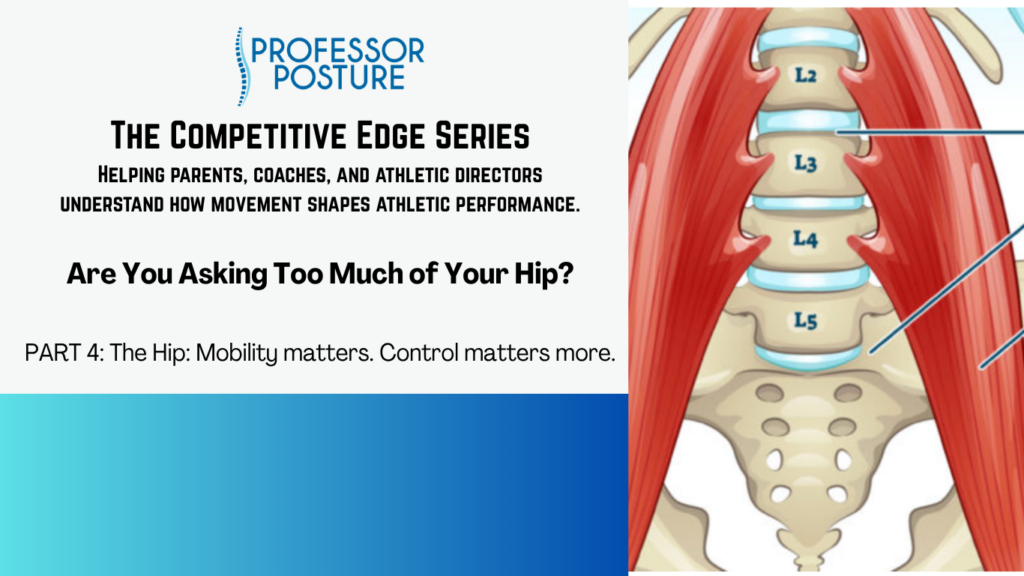
The psoas is a deep muscle that sits inside the body along the front of the lumbar spine, underneath many of the muscles closer to the surface.
It attaches along the lumbar spine, travels down through the pelvis, and connects to the femur, the large bone of your thigh.
That location makes the psoas particularly interesting.
It literally creates a connection between the trunk and the leg, which means it can play a role in what happens around both the spine and the hip.
And no, that doesn’t mean the psoas is some magical emotional storage tank that knows you’re stressed because your boss sent you an email.
It means anatomy matters.
The psoas has physical connections to both the spine and the hip, so how it works can influence how those areas interact with one another.
That becomes especially important when we’re talking about hip mobility, hip stability, and movement control.
The Psoas Does More Than One Job
One of the reasons the psoas gets misunderstood is that people like simple explanations.
“It’s a hip flexor.”
Technically, yes.
But that’s a little like saying a Swiss Army knife is a knife.
It’s not wrong. It’s just missing most of the story.
The psoas can contribute to hip flexion, meaning it can help bring your thigh toward your torso. That’s useful when you’re walking, climbing stairs, getting into a car, or getting up from a chair.
But the psoas doesn’t only matter when you’re actively lifting your leg.
It also has an important role in controlling movement and helping stabilize the hip and trunk.
And depending on what the rest of your body is doing, the psoas can participate in controlling the relationship between the pelvis, hip, and lumbar spine.
That’s why I don’t like thinking about muscles as simply being “on” or “off,” or as muscles that are either “tight” or “loose.”
Your body doesn’t work like a light switch.
It works more like a really complicated team.
Hip Flexion vs. Hip Extension
Let’s make this practical.
When you lift your knee toward your chest, you’re moving into hip flexion. The psoas can help produce and control that movement.
But what happens when your leg moves behind you?
That’s hip extension.
And this is where things get interesting.
The psoas isn’t simply sitting there waiting for its one opportunity to pull your leg forward. It can also play a role in controlling what happens as the hip moves into extension.
Think about walking.
As one leg moves forward, the other leg moves behind you. Your hip has to move through flexion and extension while your pelvis and trunk remain controlled.
Now increase the demand.
Think about sprinting, accelerating, stopping, jumping, cutting, and changing direction.
Your hips have to move through a much larger range of motion, much faster, while your body maintains enough stability to produce and control force.
The psoas is part of that equation.
That’s one reason the psoas matters to athletes—and why understanding hip control isn’t just something for people dealing with hip pain or lower back pain.
It’s also relevant to people who want to move better and perform better.
For a young athlete, poor hip control can become particularly noticeable when the demands on the body increase. Sprinting in a straight line is one thing. Sprinting, stopping, cutting, and changing direction is another.
Your body has to be able to control the movement it’s creating.
Mobility Isn’t the Same as Flexibility
Here’s an important distinction.
Mobility is your ability to move through a range of motion with control.
Flexibility generally refers to the ability of muscles and other soft tissues to lengthen.
They’re related, but they’re not the same thing.
And neither one is particularly useful if you don’t have the ability to control and stabilize the movement.
You can have plenty of flexibility and still have poor control.
You can have a large range of motion and still have difficulty using that range effectively.
And you can stretch something over and over again without addressing why your body is restricting the movement in the first place.
That’s why “just stretch it” is such an incomplete answer to hip flexor tightness or limited hip mobility.
Your goal isn’t to make every muscle in your body as loose as possible.
Your goal is to help your body move through the range of motion it needs and control what happens there.
Your “Tight” Psoas May Not Need More Stretching
Here’s another idea worth getting out of the way:
A muscle that feels tight isn’t necessarily a muscle that needs to be stretched.
Sometimes a muscle feels tight because it is actually shortened.
But sometimes it feels tight because your body is using it to create stability or control a movement it doesn’t feel confident performing.
Those are two very different problems.
And treating them the same way doesn’t necessarily solve anything.
The psoas is also a deep muscle, which makes the idea of simply stretching it considerably more complicated than many online videos would have you believe.
You can’t just reach through the front of your body and grab the psoas like you’re stretching your quadriceps.
Depending on what’s actually happening, the muscle may need to be worked, not simply stretched.
Sometimes muscles need to be challenged and retrained so they can perform their job more effectively.
More stretching isn’t automatically better.
The goal isn’t to make the muscle disappear into some mythical state of permanent relaxation.
The goal is to help your body use the muscle appropriately.
The Psoas Doesn’t Work Alone
Of course, the psoas isn’t doing all of this by itself.
The hip is a complicated joint, and movement requires multiple muscles and structures to work together. The psoas is one member of that team.
And just like any team, having one member doing too much—or another member not doing enough—can change how the whole system functions.
This is where control becomes so important.
Your hip needs enough mobility to move.
It needs enough flexibility to allow that movement.
But it also needs the ability to control the movement and stabilize the body while it’s happening.
That’s true whether you’re walking across your kitchen, climbing a flight of stairs, getting out of your car, or sprinting across a baseball field.
The demand may be different.
The basic requirement isn’t.
And Then There’s Your Lower Back…
Remember that the psoas attaches to the lumbar spine before traveling down toward the femur?
That’s important.
Because your hip and your lower back don’t operate as completely separate systems.
The psoas is one of the structures that helps connect those two areas mechanically, which means how your hip moves can influence what happens around your lumbar spine—and vice versa.
This is one of the reasons hip pain and lower back pain can sometimes show up together.
It doesn’t mean your psoas is automatically the cause of your back pain.
It doesn’t mean every person with lower back pain has a “tight psoas.”
And it definitely doesn’t mean you need to start aggressively stretching your hip flexors.
It means there’s a relationship worth understanding.
And we’re going to spend a lot more time talking about that relationship when we get to the lumbar spine in the next part of this series.
If Your Psoas Just Won’t “Release”
If you’ve been told you have a “tight psoas” and you’ve tried stretching, massage, adjustments, or just about every other trick you can find—but the tightness keeps coming back or it never seems to release for long—there may be more going on than a muscle that simply needs to be loosened.
Sometimes the problem isn’t that a muscle needs more stretching.
Sometimes it needs to work differently.
If your hip doesn’t have the mobility or control it needs, your body may continue relying on certain muscles to provide stability. In that case, repeatedly trying to make the muscle “relax” may be treating the symptom rather than figuring out why the muscle is working so hard in the first place.
If you’ve been dealing with persistent hip flexor tightness, hip pain, or lower back pain, and nothing seems to make that “tight psoas” feeling stay gone, give Professor Posture Tampa a call.
Let’s take a look at what’s actually happening and figure out why your body keeps creating the same problem in the first place.
Your Hip Needs to Do More Than Move
This is really the point I want you to take away from this article.
Your hip isn’t supposed to simply move.
It’s supposed to move and control that movement.
The psoas is one of the muscles that helps make that possible.
It’s involved in hip flexion. It contributes to the control of hip extension. It works in coordination with the trunk and pelvis. It helps manage the relationship between your upper and lower body.
And it has to adjust constantly depending on what you’re asking your body to do.
Walking requires one kind of control.
Running requires more.
Sprinting, jumping, cutting, and changing direction require even more.
That’s why simply asking, “Is my psoas tight?” isn’t always the most useful question.
A better question is:
“Is my hip capable of moving through the range of motion I need—and can I actually control it when I get there?”
That’s a much more interesting question.
And it’s one of the reasons we look at the way the body moves, rather than simply trying to find one muscle to stretch.
Whether you’re dealing with hip pain, lower back pain, hip flexor tightness, or you’re an athlete looking for that extra edge, the goal isn’t simply more movement.
The goal is controlled movement.
And once you understand that, the conversation about your hips—and eventually your lower back—gets a whole lot more interesting.