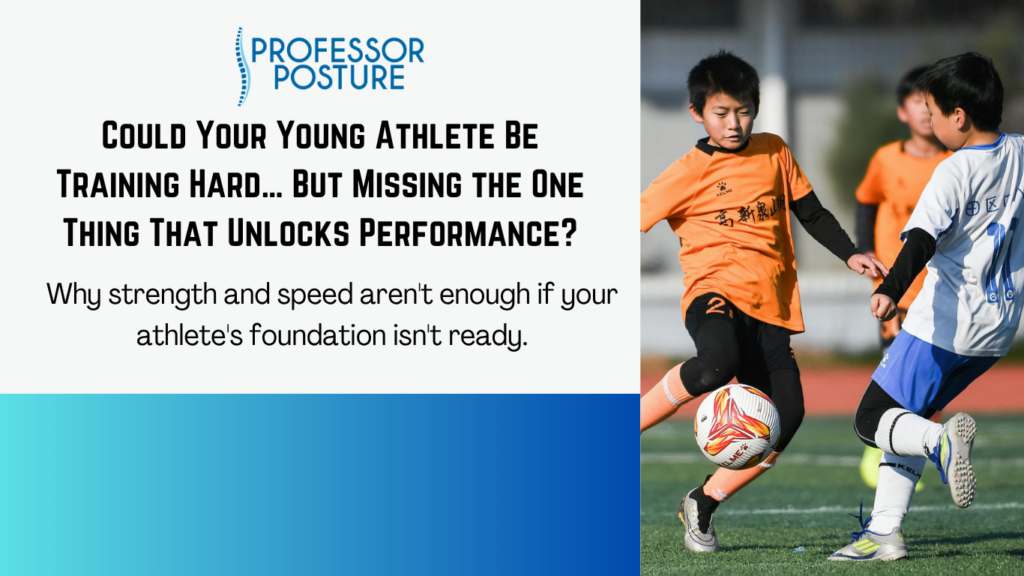
Why strength and speed aren’t enough if your athlete’s foundation isn’t ready.
Every year, there’s a kid who misses varsity by about 2%.
Not 20%.
Not because they didn’t care.
Not because they weren’t talented.
Just…2%.
Maybe someone else’s fastball had a little more zip.
Maybe another runner found one more gear in the fourth quarter.
Maybe one volleyball player could still jump in the fifth set while another couldn’t.
Two percent.
That’s all it takes for one athlete to hear, “Congratulations…”
…and another to hear, “Keep working. Maybe next year.”
So we all go looking for another 2%.
Another lesson.
Another private coach.
Another strength program.
Another speed camp.
Another weekend tournament.
Another hour in the batting cage.
None of those things are wrong.
They’re all valuable.
But what if we’ve been looking in the wrong place?
What if the next 2% isn’t found by asking your athlete to do more?
What if it’s found by preparing their body to do what it was designed to do all along?
Your Athlete Is Practicing More Than You Think
Here’s something I tell people almost every day:
The body only gets good at what it practices.
Think about your athlete’s average Tuesday.
School.
Homework.
The ride home.
A phone.
A tablet.
Maybe a little gaming.
By the time practice starts, they’ve already spent most of the day training for the Olympic event of Competitive Slouching.
Then we expect them to uncurl, sprint, rotate, jump, throw, breathe well, absorb contact, change direction, and perform like elite athletes.
The remarkable part?
Most of them actually do.
Sort of.
Because the body hates to fail.
Give it a job it can’t quite do…
…and it’ll figure something out.
Borrow a muscle.
Shift the load.
Change the mechanics.
Find a workaround.
That’s compensation.
It’s one of the smartest things the human body does.
Until it becomes one of the most expensive.
The Athletic Foundation
Imagine trying to fire a cannon from a canoe.
The cannon may be incredibly powerful.
But if the platform underneath it isn’t stable, much of that power never reaches the target.
The answer isn’t a bigger cannon.
It’s a better platform.
Athletes aren’t much different.
Speed.
Strength.
Power.
Skill.
Endurance.
None of those abilities exist on their own.
They’re all built on something most people never think about:
An athlete’s foundation.
Your athletic foundation is the system of muscles that supports your body before it creates movement.
It’s the quiet crew behind the curtain.
Nobody buys tickets to watch them.
Nobody celebrates them after the game.
But without them, the stars don’t get to shine.
When your athletic foundation is doing its job, force transfers efficiently.
Movement feels smoother.
Breathing is easier.
Power reaches the ground instead of leaking out through compensations.
When it isn’t…
The body adapts.
Because it always does.
The Fourth Quarter Never Lies
Watch almost any game.
Early on, mechanics are clean.
Then the game gets longer.
The swing changes.
The throws lose pop.
The serve starts drifting.
The knees cave inward.
The shoulders creep toward the ears.
Parents sometimes think their athlete stopped trying.
Usually, they’re just watching fatigue expose a compensation that has been there all along.
Kids don’t lose mechanics in the fourth quarter because they forgot how to play.
They lose mechanics because fatigue exposes weaknesses.
When an athlete’s foundation gets tired…
The compensation takes over.
The Conversation No Athlete Wants
A few years ago, a high school baseball player walked into my office after accomplishing what he’d worked toward for years.
He’d made varsity.
Then his coach pulled him aside.
His shoulder wasn’t holding up.
The pain wasn’t getting better.
His doctor agreed.
His rotator cuff couldn’t handle the demands of a varsity season.
He had to walk away.
Imagine earning the spot you’d dreamed about…
…only to spend the rest of the season watching from the stands.
He didn’t need another pitching coach.
He didn’t need another lesson.
He didn’t need to want it more.
He needed a body that could support the opportunity he’d worked so hard to earn.
Over the next several months, we rebuilt his athletic foundation.
Not his fastball.
Not his arm strength.
The platform underneath both.
The following fall, he earned his varsity spot back.
Today, he’s entering his senior year, and several colleges are recruiting him with scholarship opportunities.
His talent didn’t suddenly appear.
His athletic foundation finally allowed that talent to show up consistently.
When More Training Makes the Wrong Thing Stronger
Another athlete came to me after her volleyball performance suddenly started falling apart.
Her serves lost power.
Her returns became inconsistent.
The harder she practiced…
…the worse she played.
Her parents did what almost every caring parent would do.
They added more training.
Three strength sessions every week.
On top of four volleyball practices.
She got stronger.
She also got worse.
That sounds backwards.
Until you realize one simple truth.
Strength doesn’t fix compensation.
It amplifies whatever movement pattern already exists.
If movement is efficient, strength becomes a superpower.
If movement is full of workarounds, strength reinforces the workarounds.
We spent less time building bigger muscles…
…and more time rebuilding her athletic foundation.
Once that happened, all the strength she’d worked so hard to build finally had somewhere to go.
Her mechanics returned.
Not because she suddenly became stronger.
Because her body finally stopped fighting itself.
Try This Tonight
I call it the Two-Minute Sit Bone Challenge.
Have your athlete sit on a firm chair.
Find the two bony points underneath their pelvis—their sit bones.
Sit directly on them.
Ears over shoulders.
Shoulders over hips.
No leaning.
No slouching.
No backrest.
Set a timer for two minutes.
Then watch.
How long before they start shifting?
Leaning?
Crossing a leg?
Looking for something to support them?
Ask them what they’re feeling.
If those muscles start getting tired quickly, don’t panic.
Smile.
You just found one of the easiest places to help them improve.
Don’t Forget About Oxygen
Every sprint.
Every jump.
Every serve.
Every inning.
Every point.
Working muscles run on oxygen.
The more efficiently an athlete breathes, the more efficiently they can fuel movement throughout a game.
Yet many young athletes spend most of the day in positions that make efficient breathing harder before practice even begins.
Sometimes improving performance isn’t about teaching the body to work harder.
Sometimes it’s about removing the obstacles that have been quietly making it work harder all day long.
What If the Difference Really Is 2%?
Maybe your athlete does need another batting lesson.
Maybe they do need another speed camp.
Maybe they do need another strength program.
Those things absolutely have their place.
But before you ask the body to produce more speed…
More power…
More endurance…
Ask a different question.
Does my athlete have the athletic foundation to support it?
Because every year, there’s a kid who misses varsity by about 2%.
No one can tell you exactly where that 2% comes from.
Sometimes it’s another hour in the cage.
Sometimes it’s another drill.
Sometimes it’s another workout.
And sometimes…
It’s giving the body the athletic foundation to finally express the ability that was there all along.
The athletes who separate themselves aren’t always the ones who work the hardest.
More often than not…
They’re the ones whose bodies are finally prepared to let all that hard work pay off.