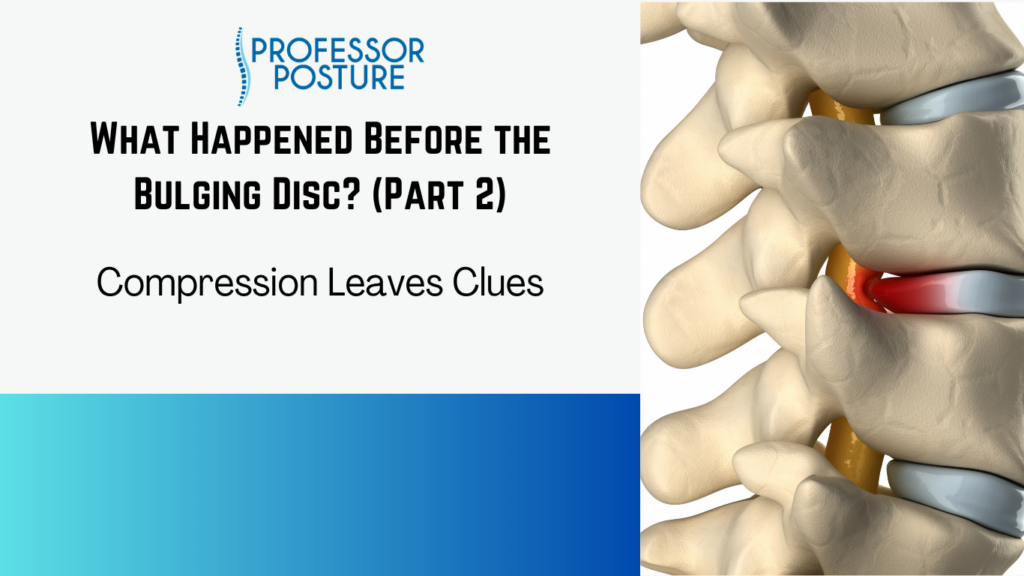
Compression Leaves Clues
One of the biggest mistakes we make is assuming pain is the first sign that something is wrong.
It usually isn’t.
Long before your back hurts…
Long before your neck starts aching…
Long before an MRI shows a bulging disc…
Your body often leaves clues.
I’ve learned over the years that helping people often starts by teaching them to become detectives instead of patients.
Your body has been leaving clues for years.
The challenge isn’t finding them.
It’s learning how to recognize them before the whispers become screams.
One of my favorite self-tests doesn’t require expensive equipment, fancy technology, or even leaving your house.
It starts in your closet.
Go grab the oldest pair of shoes you own.
Flip them over.
Really look at the bottoms.
Ask yourself:
- Is one heel worn down more than the other?
- Is the outside edge of one shoe disappearing faster?
- Does one toe wear through before the other?
- Does one shoe simply look older than its partner?
“Your shoes don’t give you a diagnosis. They give you clues.”
Uneven wear patterns don’t automatically mean you have a spinal problem.
But they may suggest your body has been distributing force differently from one side to the other every time your foot hits the ground.
Multiply that by thousands of steps every week…
Millions over a lifetime…
Those little clues begin telling a much bigger story.
Your shoes may have noticed long before you did.
Why Walking Often Feels Better Than Yard Work
Let’s go back to the question we started with.
Why can you spend Saturday hiking, walking around Busch Gardens, or exploring downtown Tampa and feel pretty good…
…yet wake up Monday morning feeling like your back aged twenty years after spending Sunday gardening?
The answer isn’t that gardening is bad.
It’s that your body experiences those two activities very differently.
When you walk, your body is constantly changing.
Your hips rotate.
Your pelvis shifts.
Your trunk twists.
Your muscles continuously share the workload.
Compression is constantly moving.
No single structure carries the exact same force for very long.
Now picture yourself pulling weeds for three hours.
Or pressure washing the driveway.
Or painting baseboards.
Your spine stays in a similar position.
Your discs experience sustained loading.
The muscles that normally help distribute those forces begin getting tired.
As they fatigue, more of that work may begin transferring into passive structures like joints, ligaments, and spinal discs.
The activity itself isn’t necessarily the problem.
It’s how long your body has to manage the same forces without much variation.
The same thing often happens during prolonged sitting.
“Movement changes compression. Staying in one position allows compression to accumulate.”
When the Hinge Stops Moving
Over the years, I’ve noticed a pattern.
Many people dealing with chronic low back pain don’t simply have a painful back.
Somewhere along the way, one side of the pelvis stopped sharing the workload as well as it used to.
One possible contributor we commonly see during a movement assessment is reduced motion through one side of the pelvis, particularly around the sacroiliac (SI) joint.
Think back to the door analogy.
Your legs are the door frame.
Your upper body is the door.
Your hips are the hinges.
When the hinges move well, the door swings open effortlessly.
When one hinge begins sticking, the door still opens.
Just not as smoothly.
Eventually the frame starts rubbing.
The paint chips.
The latch doesn’t quite line up anymore.
The paint wasn’t the problem.
It simply revealed that something underneath wasn’t moving the way it should.
Your body often works the same way.
When one side of the pelvis gradually loses motion, the lumbar spine may begin absorbing forces it wasn’t designed to handle by itself.
Does that automatically create a bulging disc?
No.
Could it be one possible contributor over months or years?
Absolutely.
“When the hinge stops moving well, the door isn’t the first thing to change. It’s simply the first thing you notice.”
Why Does It Feel Better When You Lie Down?
One of the most common questions I hear is:
“If I have a bulging disc, why do I usually feel better after lying down?”
For many people, lying down simply changes the amount of compression traveling through the spine.
You’re no longer supporting the weight of your upper body against gravity in the same way.
The muscles that have been working all day finally get a chance to relax.
If a nerve has been irritated because the available space around it became crowded during weight-bearing activities, reducing that compression may temporarily reduce the irritation.
That may help explain why some people wake up feeling much better than they did the night before.
Of course, not everyone experiences relief lying down.
Every body is different.
The important lesson isn’t that lying down “fixes” the problem.
It’s that changing the mechanical load often changes the symptoms.
What About Surgery?
If your symptoms have progressed to the point where surgery is the best option, that is a decision only you and your physician can make.
For many people, procedures that create more room around an irritated nerve can be life-changing.
The question I encourage people to ask isn’t whether surgery is good or bad.
It’s whether we’ve also addressed the movement patterns that may have contributed to excessive loading in the first place.
Surgery may successfully create more space around a nerve.
It doesn’t automatically restore pelvic mobility.
It doesn’t retrain muscles that have become underactive.
It doesn’t change years of movement habits.
If those movement patterns remain unchanged, neighboring discs may eventually be exposed to many of the same forces that affected the first one.
“Creating more space around a nerve doesn’t automatically change the movement patterns that created the excessive loading in the first place.”
Looking Beyond the Pain
One thing I’ve learned after years of working with people across the Tampa Bay area is this:
Pain gets our attention.
Movement tells us the story.
At Professor Posture, we don’t spend our time chasing symptoms.
We spend our time asking better questions.
Why is one side carrying more load than the other?
Why is one hip moving differently?
Why are certain muscles doing all the work while others have quietly stepped out of the game?
Those questions guide everything we do.
Our corrective posture therapy begins with a detailed movement assessment.
We look at posture, walking mechanics, pelvic movement, spinal mobility, balance, muscle function, and weight distribution.
The goal isn’t to “put a disc back in.”
The goal is to help your body manage compression more efficiently so one structure isn’t constantly being asked to do the work of many.
“We don’t chase symptoms. We look for the movement patterns that came before them.”
A Lesson I Learned the Hard Way
Everything I’ve shared in this article isn’t just something I’ve observed in clients.
It’s something I’ve lived.
Years ago, I was deeply involved in powerlifting.
Like many lifters, I believed heavier always meant better.
To move more weight, I repeatedly forced my thoracic spine into an exaggerated arch.
At the time, I thought I was improving my lifting mechanics.
Looking back, I was repeatedly asking the same area of my spine to absorb forces it wasn’t designed to manage over and over again.
Eventually, I developed spondylolisthesis in my thoracic spine.
Do I think weightlifting is bad?
Absolutely not.
Strength training is one of the best investments many people can make in their health.
But it taught me a lesson I carry into every posture assessment I perform today.
The body adapts to the loads we repeatedly ask it to carry.
Sometimes those adaptations help us.
Sometimes they’re simply clues that the body has been working overtime for a very long time.
In our last article, we talked about how nerves tell muscles what to do.
In this article, we’ve explored how pressure tells discs what to do.
Next time, we’ll continue following the clues by looking at another adaptation that often worries people: arthritis.
Because just like discs…
Joints have a story to tell, too.
“Your MRI is a photograph. Your movement is the movie.”
“Your body whispers long before it screams.”